Becoming an Expert with Impact
Strengthening Influence Without Compromising Expertise
You are an expert in your field. You have invested years developing deep knowledge, disciplined reasoning, and evidence-based judgment. Yet, you have just left a strategic meeting, and your voice carried less weight than the person with the flashy sales pitch.
It was not because your analysis was weak. It is because expertise and influence operate according to different rules.
Research on strategic decision-making over the last twenty years shows that modern organisations believe they are rational, but rarely make important decisions through rational, linear analysis. Even when organisations adopt borderline mathematical evaluation frameworks, the final solution is rarely a pure mathematical exercise.
Instead, important decisions emerge from complex social processes rather than from rational analysis alone. Decisions unfold through discourse, negotiation, and shifting power dynamics that constantly change.
If you remain solely inside your analysis, you may be correct, but being logically correct does not necessarily translate to influencing a decision. Your ability to influence in your organisation does not replace your expertise. Instead, influence skills will often determine whether your expertise shapes outcomes and decisions.
Why Technical Brilliance Alone Is Not Enough
Most large organisations have competing priorities such as revenue, operational risk, brand reputation, employee engagement – to name but a few. Organisations and their leaders are trained to balance these. Experts however, are trained to optimise a beautiful solution.
Deep subject matter experts by nature or necessity are often perfectionists, and may insist on certainty before they feel comfortable advising on an important decision. As a result, friction and frustration may occur between two parties who may look at the world in different ways.
Furthermore, strategic decision-making is not a series of presentations to the executive team. Strategic decisions are often a result of incremental discussions, including impromptu watercooler and hallway chats. Research highlights that most decision processes occur socially over time rather than unfolding like a waterfall project plan.
This reality may be uncomfortable for. It can feel imprecise. At times, you may have called it inefficient or playing politics.
But politics is just human nature by another name. Evolutionary psychology clearly explains organisational politics as a natural byproduct of social beings navigating groups where resources are limited, and goals are diverse. It’s a reality that if you want to shape strategic outcomes, you need to position yourself inside this reality rather than outside it.
The Invisible Barrier to Influence
Even when experts are present in meetings where strategic decisions are being made, their input may be filtered out.
Research published in Management Decision examining group bias demonstrates that leadership teams are actually human beings (shocking, I know) and are prone, like the rest of us, to groupthink, social influence, and under-the-radar personality conflicts. Any distinct group, like a leadership team, will frequently prioritise shared understanding over unique insights from outside the group. The most technically gifted expert can therefore be marginalised if it abruptly disrupts the view of the group.
History is full of disastrous examples, which became apparent catastrophically only in hindsight:
· The Challenger space shuttle
· The Boeing 737 MAX crisis
· Kodak ignoring their first digital camera
When expertise is sidelined, the cost is rarely immediate. Which brings me to the core reason why I do what I do. This is not merely about supporting career advancement for experts in organisations. It is a critical responsibility for experts to ensure they are heard, and for the rest of us to listen.
The Study of Political Skills
Many experts I have worked with as clients resist the idea of “playing politics” because it feels dirty or not aligned with their values. However, political skill research defines influence as the ability to understand others and use that understanding to align objectives effectively. You could also call this emotional intelligence or what the Expertship Institute calls stakeholder engagement.
Studies seeking to assess political skill show that it is measurable, can be developed, and strongly correlates with career effectiveness. Four of the dimensions that can be assessed and learned are:
Social astuteness: accurately reading motivations and informal power structures
Interpersonal influence: adapting communication style without diluting substance
Networking ability: cultivating diverse relationships
Apparent sincerity: demonstrating authentic integrity and consistency
These are not manipulative tactics. They are competencies that relate to human motivations and relationships. Experts who develop them expand their impact and reach while not abandoning their values.
The skills behind political skills are also grounded in behavioural science. Robert Cialdini’s research on the principles of persuasion identified that people rely on a wide range of cognitive shortcuts or human-biases, particularly when under pressure. Commitment, social proof, reciprocity, authority, liking, and the strategic sequencing of information all shape decision outcomes. In fact, evolution has given us over 180 biases to help us reduce cognitive load to reduce the number of calories our brain, our most energy-demanding organ, needs to think.
To overcome these obstacles, an expert who builds cross-functional support (a politically correct term for “lobbying”) BEFORE presenting a recommendation will more likely be successful than someone who puts all their hopes and effort into a single presentation to the executive team.
This is how decisions are actually made. Influencing for impact is not a singular tactic, but more like a campaign requiring proactive relationship building. Your executives know this and have likely become effective at it. It is a learnable skill that does not undermine the importance of your expertise but magnifies it.
Authenticity Is Non-Negotiable
Your ability to sustain influence and impact over time depends on trust. Trust is not built in a single presentation. It is developed through consistent behaviour, clear communication, and alignment between your words and actions.
A common fear among experts is that greater influence requires performative theatre - that you need to act in a way that is not authentically you. Authentic leadership research shows the opposite. Sustainable leadership and influence rest on four pillars: Balanced Processing, Relational Transparency, Self-Awareness, and Internalised Moral Perspective.
The study of authentic leadership and expert power shows how these four pillars align with the ability of experts to influence and lead, even if they don’t manage people. And yes, expert power is a thing.
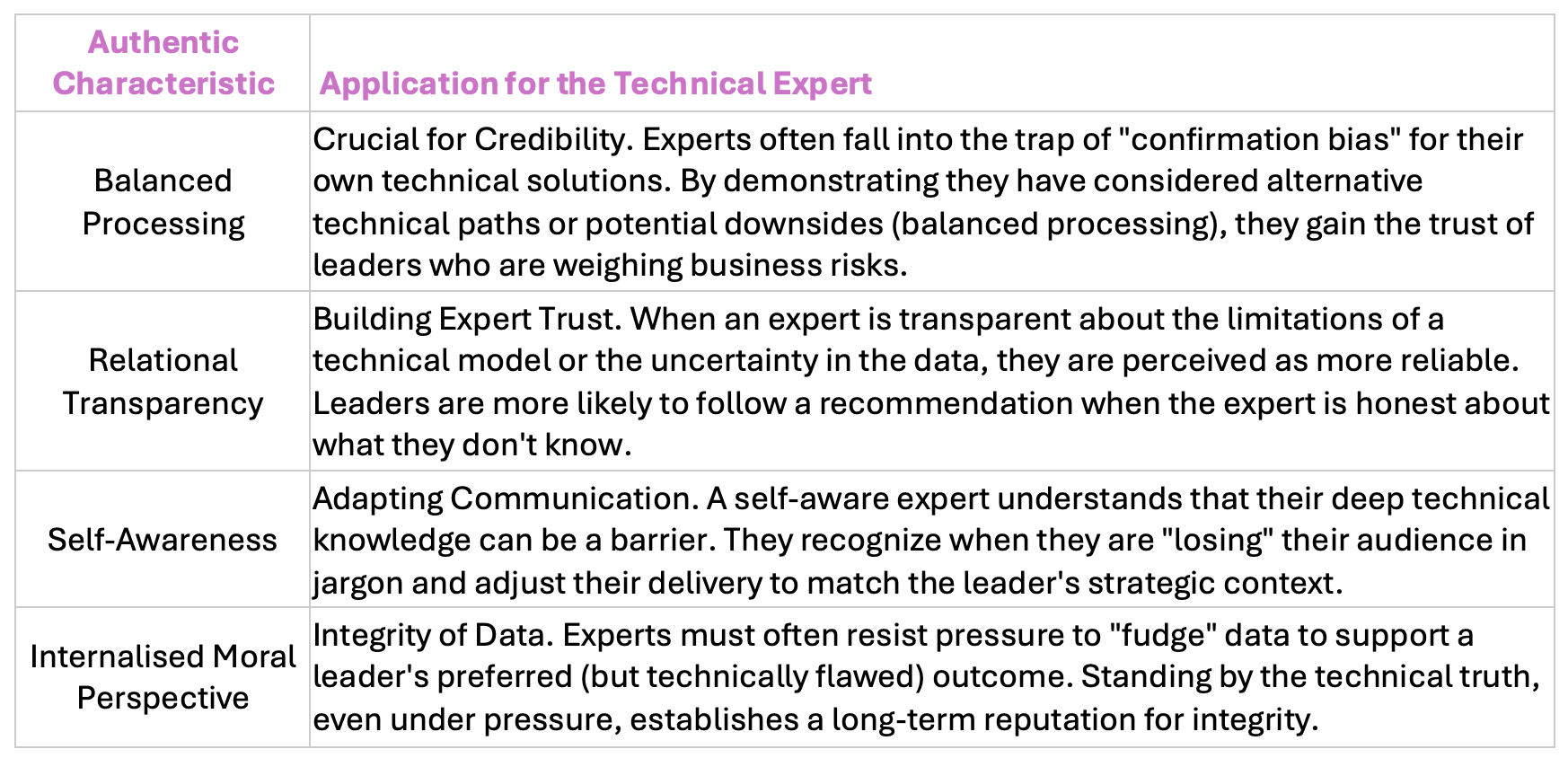
You do not need to become louder versions of yourself. Instead, consider increasing your need to understand how your expertise lands, how others experience your communication, and experiment with small, disciplined adjustments to strengthen clarity and receptivity.
This is deliberate practice. The real work is in the boring middle. It is rarely glamorous, but it is highly consequential.
Reclaiming Your Seat at the Table
When the most knowledgeable person in the room lacks influence, the organisation does not merely miss an opportunity. It increases risk because speed replaces scrutiny. Confidence substitutes for judgment, and groupthink will eventually override any technical dissent.
Strengthening your influence requires disciplined and deliberate effort:
Practising political skill as a legitimate professional competency
Proactive relationship building and stewarding your knowledge across silos
Applying influence techniques ethically
Accepting your expert power as a tool for responsible impact
Building relational capital through consistency and trust
Maintaining your authenticity as the real you
This work can be deeply personal and is neither theatrical nor immediate. It is cumulative, and success will occur over time. And it really matters. This matters because the complex problems we face require depth of expertise that lands. The world needs judgment informed by evidence. We need experts who are not only correct but influential enough for their correctness to shape outcomes.
And when practised with integrity, it strengthens our organisations, our communities, and the quality of the future we collectively shape.
I am developing an Expert Influence Self-Audit that will include the four dimensions of political skills and authentic expert power. If you would like to be informed when the first draft of this audit is available, please click here to let me know.