
The "Expert Trap”: Why Stepping Back Is Your Best Move Forward
Being the “go-to” expert can feel like career success—until your expertise makes you the bottleneck. This article explores how one highly experienced specialist escaped the Expert Trap by letting go, developing others, and shifting his focus from solving immediate problems to influencing bigger strategic decisions. His story shows why advancing as an expert often means stepping back from doing more yourself so you can create greater impact through others.

If AI Eats Your Job for Breakfast, Maybe Your Job Was Already Toast
AI is not necessarily a threat to your expertise. It is a threat to your work that has become disconnected from the higher-value judgement that your hard-won expertise should provide.
If history is anything to go by, most of us are going to be just fine. Yes, technological disruption has always caused upheaval and pain. It replaces tasks, reshapes professions, and forces people to adapt. But it rarely destroys a profession outright in the way many AI crystal-ballers are predicting. More often, it raises the baseline of what counts as routine work, allowing us to focus on increasingly complex, creative, strategic, and relational forms of contribution.
That does not mean AI will be painless. Some roles will disappear, careers will be disrupted and some people will be need to reskill faster than they would like. But for people like you with deep expertise, the question is not simply whether AI can do parts of your job. It is whether your current work still depends on the kind of expertise, judgement, influence, and enterprise value that AI cannot easily replicate.
If your role is built mainly around producing technical outputs that others, or machines, can now generate well enough, then yes, AI may eat your job for breakfast.
But if you use AI to remove lower-value work, sharpen your thinking, strengthen your influence, and apply your expertise to more important organisational problems, you may become even more valuable, not less.
The future is unlikely to belong to experts who simply know more. It will belong to experts who can also turn what they know into better decisions, stronger relationships, clearer judgement, and more meaningful impact.

Beyond Technical Mastery: What Actually Drives Influence at Work
Unlock the strategic potential of your technical talent by bridging the "influence gap" between deep expertise and executive decision-making. This article outlines how organisations and experts can shift from management-heavy oversight to expert-led innovation by leveraging social capital and adopting dual career paths.

Why Your Evidence Isn’t Enough
You may have experienced this yourself: even when your analysis is strong and your evidence is clear, you don’t always get the decision you want. This article explores why that happens. Your work does not move through a purely logical process. It moves through people, and those people are influenced by priorities, time pressure, habits, and how information is presented. That does not mean your expertise is lacking. It means the environment you are working in is more complex than it first appears. The article provides pragmatic ways to think about influence as part of your role as an expert. It shows how small changes in how you frame and communicate your insights can help others understand and act on them, without compromising the quality or integrity of your analysis.

Translating Expertise into Strategic Impact
From Technical Expert to Strategic Partner: How to Amplify Your Influence
Have you ever presented a brilliant, data-backed solution only to see it stall because decision-makers couldn't grasp its strategic value? You are not alone. Many highly skilled technical experts struggle to connect their complex analyses to their organisation's high-level goals, often colliding with invisible barriers like the "curse of knowledge," deeply ingrained workplace silos, and the mental fatigue of switching between tactical and strategic thinking.
However, stepping out of this execution trap doesn't mean you have to abandon your technical mastery. In fact, it is an empowering opportunity to multiply your impact. In this article, we explore actionable ways to bridge the gap—from developing "T-shaped" capabilities that blend technical depth with business empathy, to consciously climbing the "ladder of abstraction" to tailor your message. Discover how you can frame your data within a compelling strategic narrative, translate your expertise into undeniable business value, and become a driving force behind your organisation's success
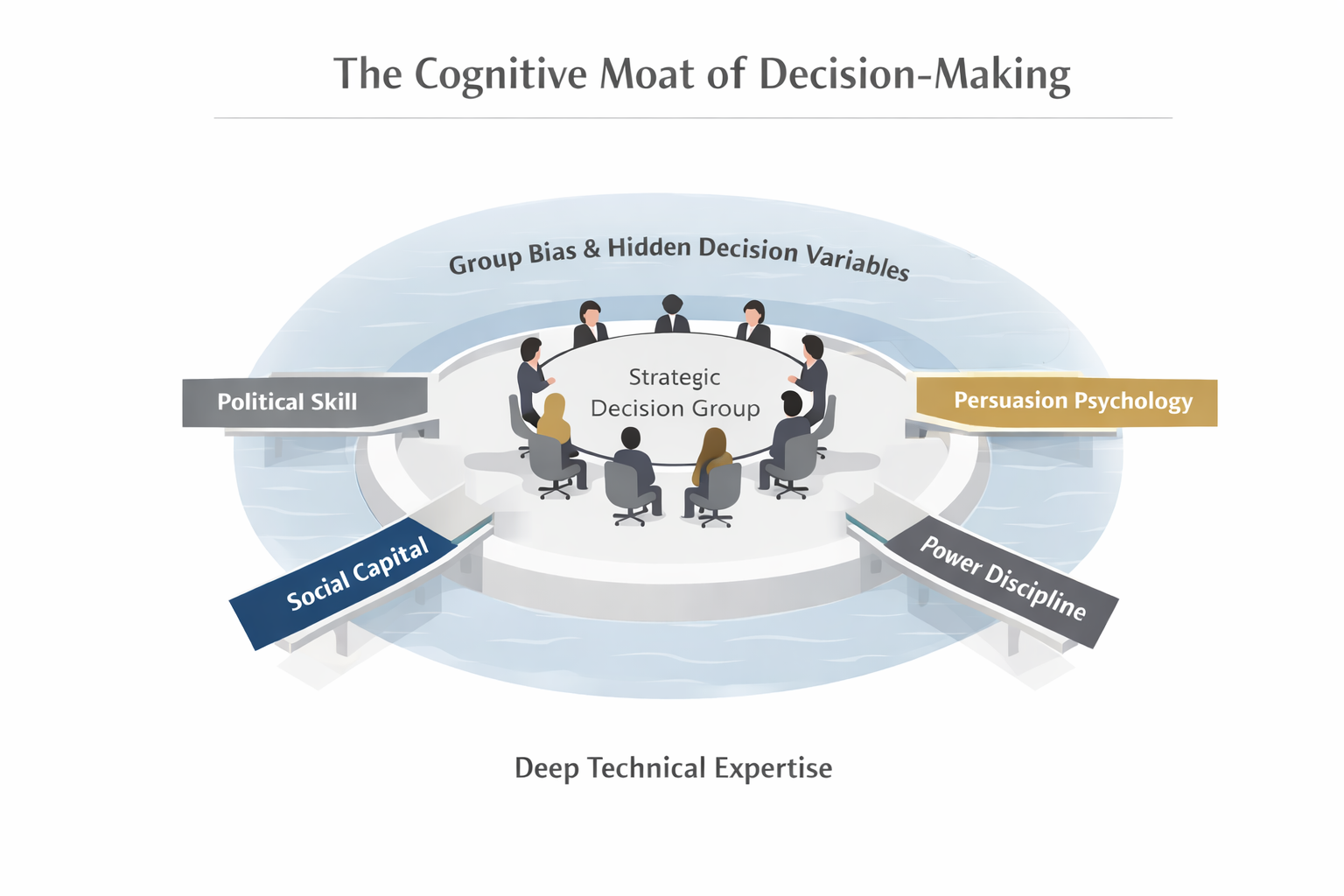
The Cognitive Moat of Decision Making
Deep subject matter expertise is essential, but it is rarely enough to shape decisions inside complex organisations. Strategic choices emerge through social dynamics, hidden variables, cognitive bias, power structures, and group identity, not evidence alone. When experts rely solely on technical correctness, their insight can be sidelined despite its quality. Influence therefore requires additional disciplined capabilities: understanding political skill as a professional competency, building social capital before critical moments, applying evidence-based persuasion principles, managing reputation and authority responsibly, and communicating with authenticity while adapting to context. Reclaiming influence is not self-promotion; it is stewardship, ensuring that rigorous thinking, ethical judgment, and deep expertise are heard and acted upon where it matters most.
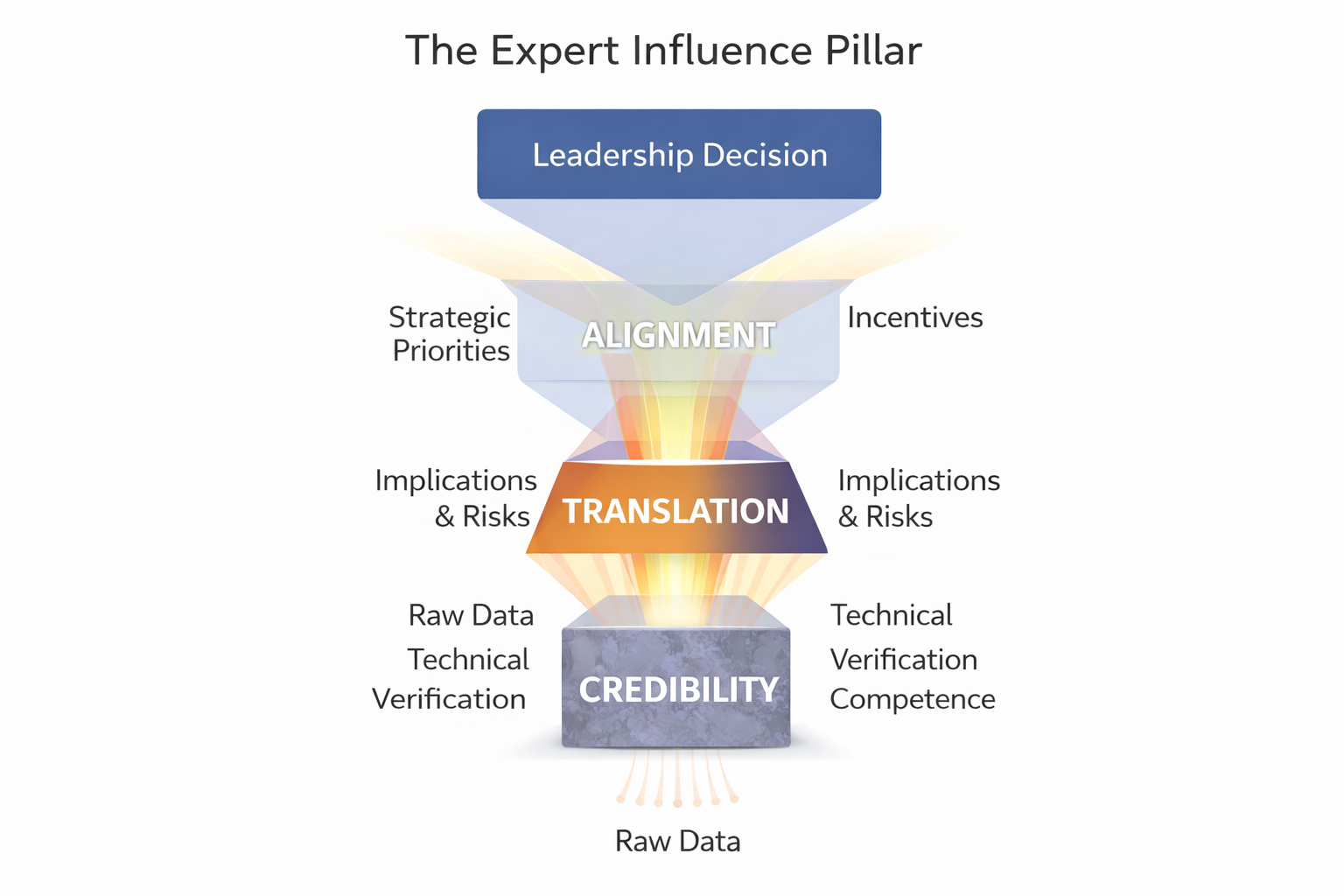
The Architecture of Expert Influence
Why do decisions still move in directions that seem disconnected from the best analysis?
In complex organisations, influence does not flow automatically from competence. It is shaped by human systems, incentives, timing, power dynamics, and decision architecture. When experts rely solely on technical excellence, they often encounter frustration—not because they are wrong, but because they are incomplete in how influence is exercised.
This article introduces a practical framework for understanding expert influence through three interdependent layers.
Becoming an Expert with Impact
Deep expertise no longer guarantees influence. Research shows that important decisions in organisations and communities emerge through social dynamics, informal networks, and power structures, and less through through rational analysis and logic.
This article explores why technical brilliance alone is often insufficient, how political skill and authenticity amplify expert impact, and what disciplined, ethical influence looks like in practice. If you want your expertise to shape real decisions without compromising your integrity,this will show you how.