Beyond Technical Mastery: What Actually Drives Influence at Work

Introduction
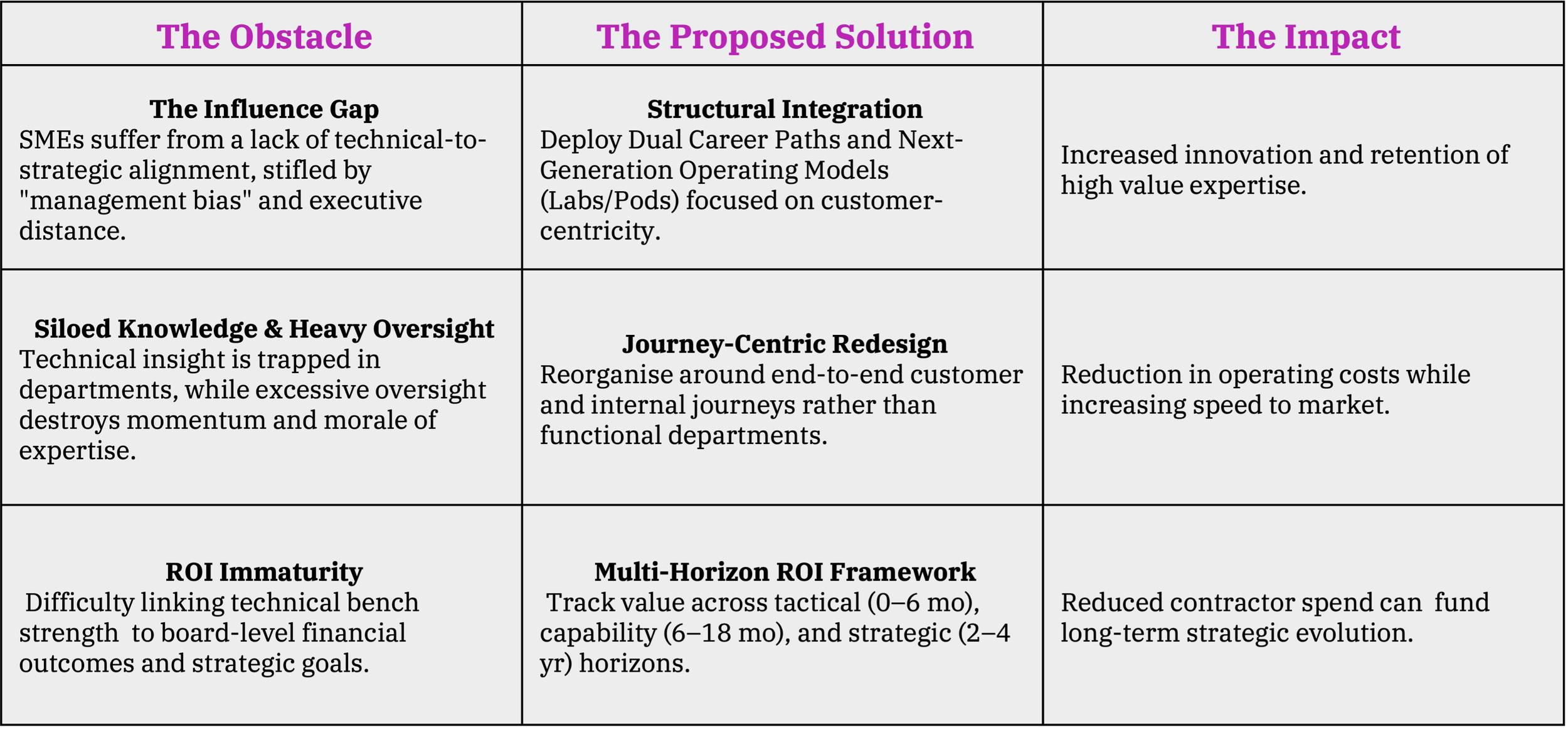
The key idea in this article is that organisational performance and innovation are directly dependent on the alignment of internal subject matter expertise with an organisation’s approach to decision-making. An "influence gap" exists where technical professionals may be stuck in their functional silos, which can lead to poor decisions about resourcing, funding, and a failure to anticipate or capitalise on emerging trends. Success requires a transition to new operating models where internal experts are empowered as strategic architects rather than transactional advisors to key decision makers.
Obstacles to Empowering Expertise
Key Insights
The research reinforces that technical mastery is a baseline requirement, but the true driver of internal experts to have organisational impact is the level of trust and reciprocity known as “Social Capital”.
Trust is the Engine of Innovation: Management overreach, too much oversight, or micromanagement of internal experts destroys engagement and stalls internal career development.
Silos Stifle, Journeys Scale: Real value can disappear or be reduced in functional hand-offs between departmental silos. Expert-heavy organisations must shift from management-centric coordination to structuring their organisation around end-to-end journeys of external and internal customers.
Social Capital as a Change Catalyst: Individuals with the strongest social networks emerge as the true influencers in an organisation, regardless of their formal position in the hierarchy.
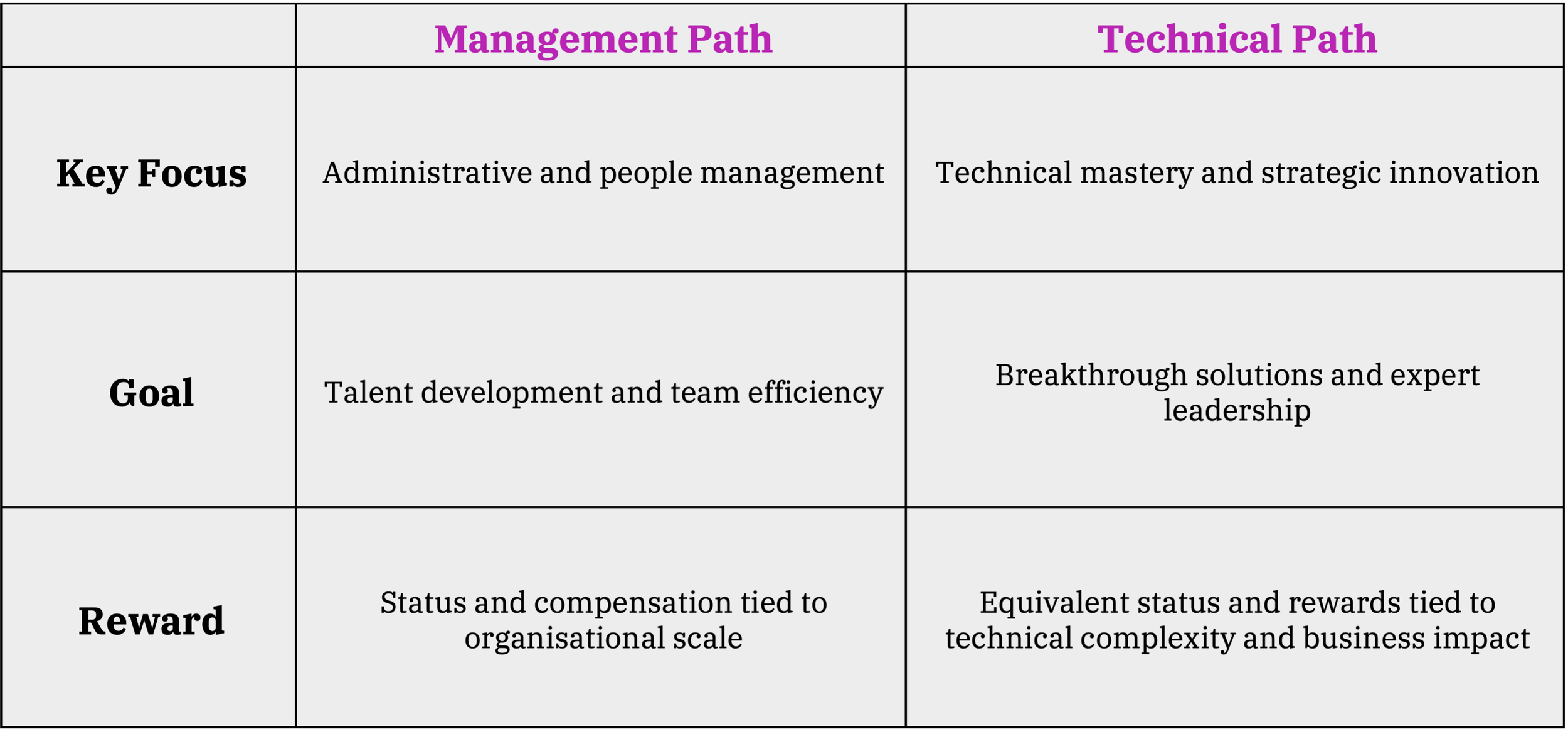
Dual Career Paths: To best retain and engage expert talent, technical career paths must offer status and rewards equivalent to managerial roles.
Strategic Visibility Drives Investment: The visibility gap between technical efforts and board-level objectives is a key reason some high-value expert-led initiatives are cut during budget reviews.
The Influence Gap: Obstacles Facing Subject Matter Experts
The Executive Visibility and Credibility Gaps
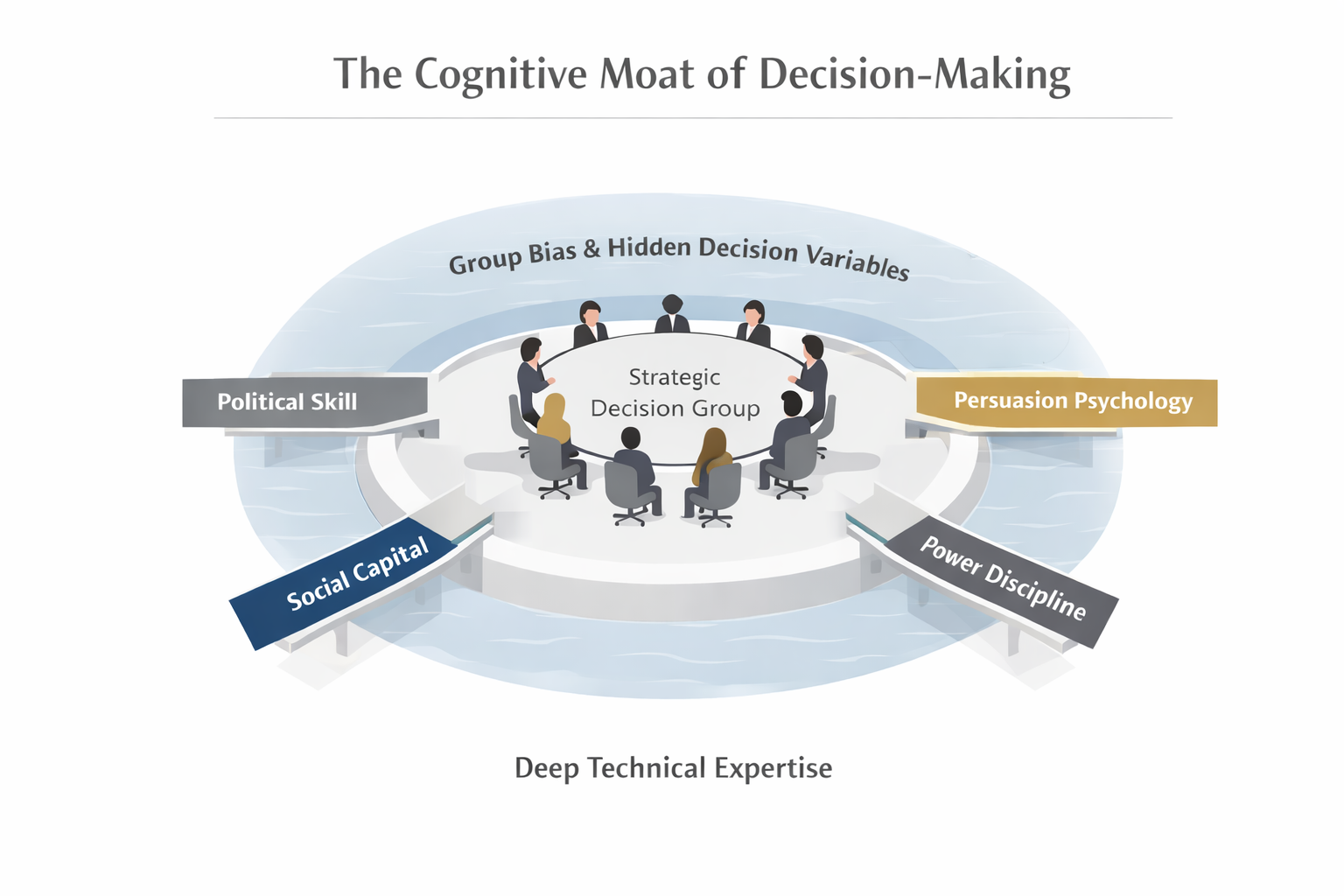
A lack of regular engagement between technical execution and those driving strategic vision creates a significant risk of misallocating funds and resources. Experts often find their individual contributions invisible to the board because they themselves may initiate solutions that don’t contribute directly to business outcomes. Or their analysis is not adequately communicated through multiple layers of management. (You can read more on this here about the cognitive moat of decision making). This results in an "Influence Gap," where strategic insights from internal experts can be overlooked in favour of managerial voices, or at best, misrepresented by managerial roles.
The Detrimental Effects of Management Overreach
Management overreach is a destroyer of trust, engagement, and innovation for everyone. My experience is that it is particularly so for people with deep subject matter expertise. It induces a risk-averse environment that can limit the organisation's ability to adapt to emerging technical trends and threats that internal experts are more likely to identify before anyone else. Specifically, management overreach stifles value through:
Excessive Control: Dictating every step of a project removes the autonomy necessary for experts to experiment, test hypotheses, and discourages nonlinear thinking to complex problems.
Lack of Trust: Constant monitoring, reporting, and management coordination sends a signal of implied inadequacy and limits the time required for deep, complex problem-solving.
Homogenization of Ideas: By suppressing individuality and unique perspectives, micromanagement prevents the diverse problem-solving required for breakthroughs, leading to safe solutions that can survive layers of management oversight and reporting.
The Management Bias
Many organisations suffer from an unconscious bias like the halo effect and the authority bias, that equates success and credibility exclusively with leadership. This management bias unknowingly undervalues diverse and expert voices, leading to frustration, disengagement, and loss of motivation among specialists. This will contribute to lower retention, where the most talented experts seek external opportunities that offer the professional growth and influence denied to them internally.
Individual Solutions: Strategies for Personal Influence
Experts can maximise their strategic impact by adopting certain traditional leadership traits without abandoning their technical identity. To strengthen your level of influence and build your social capital, as an expert, you should consider following tactics and a checklist:
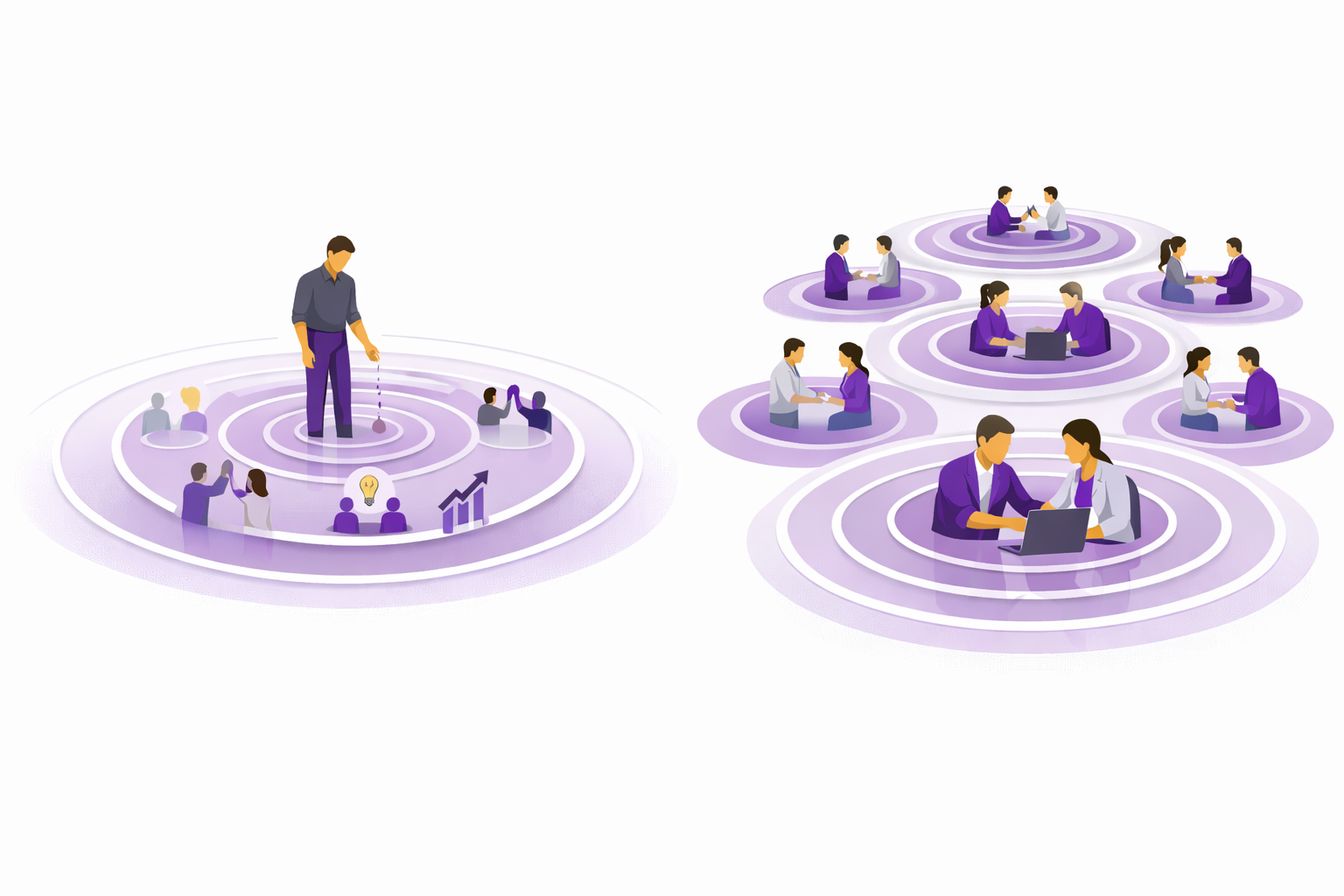
Teaching others to fish: Identify the unique technical and knowledge contributions that only you can make – those tasks and responsibilities that take years to master. Then identify those tasks that others could do for themselves for which you have become a bottleneck. Others may not be able to complete the task to as a high quality or as quickly as you, but it often doesn’t need to be. Coach, mentor, and teach your stakeholders to become less dependent on you.
Get out of your own head: Practice and develop your active listening skills to understand what is most important to your audience and then translate technical solutions into the context that matters to your audience.
Build Social Capital: Influence is built on reciprocity, not just raw data and logical solutions. The more people feel that you genuinely understand them and are genuinely curious about their rationale, the more they will reciprocate that back. If you want to be understood, first seek to understand.
Checklist for Building Social Capital
[ ] Map Your Stakeholders: Identify the informal networks that sit outside the visible organisational structure. Find the key influencers within the organization to understand who appears to drive change. Build your social capital with them and identify those who might be the early adopters of your ideas and solutions.
[ ] Seek Multi-Directional Feedback: Regularly seek to understand your stakeholders’ drivers, motivations, and fears, and do so with genuine curiosity. Seek feedback and test your ideas with senior leaders on how your expertise can better support their specific business challenges and individual concerns.
[ ] Emotional Reasoning: Humans are not rational decision makers. Although your solutions may make logical common sense, others will have emotional and irrational reasons for supporting or opposing your rational idea. Try to predict what others’ emotional decision criteria might be and test your hypotheses by genuinely seeking to understand their perspective.
[ ] Be self-aware of your presence: Couple your technical accuracy and rigour with a physical presence that encourages trust. Being self-aware of some simple things can make a big difference:
· open body language and good posture
· eye contact
· leaning in toward the person who is speaking
· asking open questions
· matching their energy level
[ ] Bridge the Strategy: Always link technical ideas and solutions to the "So What?"—the economic or strategic benefit to the organisation.
Organisational Solutions for Leveraging Expertise
The Dual Career Path Model
In expert-heavy organisations, to ensure experts are valued as highly as managers, organisations must modernise their structures and HR systems. The goal is to provide similar rewards for expertise as people leaders, to reduce the pressure on specialists to move into unwanted or unnecessary managerial roles.
Expert Friendly Operating Models
By implementing cross-functional labs or customer pods, organisations can reduce the impact of bureaucracy and functional handovers. These pods focus on end-to-end customer journeys rather than functional silos, allowing for more rapid iteration and collaboration between experts across multiple technical domains.
Reduction of bureaucracy and decision bottlenecks
· Smaller, cross-functional teams reduce bureaucracy and eliminate hand-over wait times, enabling faster decision-making.
· Cross-functional structures centred on a customer journey can replace rigid hierarchies and reduce dependencies on other teams.
Insulation from silo-driven inefficiencies
· Cross-functional teams bring all required capabilities together, avoiding inter-departmental friction and bureaucracy.
· Cross-functional collaboration explicitly breaks down silos, aligning teams around shared goals rather than departmental objectives.
Faster iteration and rapid delivery
· Cross-functional agile teams enable rapid iteration and continuous improvement because all required skills related to a specific customer journey are embedded within the team.
· Customer-centred cross-functional teams work in short cycles to deliver incremental value and adapt quickly because they are closer to the customer’s feedback.
Summary
Internal expertise is usually underutilised in our organisations due to siloed structures, management bias, leadership oversight, and limited visibility at the strategic level. However, organisations are not solely to blame. Experts who rely on their expertise alone will struggle to have an impact because impact is driven by trust, social capital, and alignment with organisational priorities. To address this, experts need to build influence through stakeholder empathy, communication, and strategic framing of their work. At the same time, organisations can introduce structural changes such as dual career paths and cross-functional, customer-focused teams that reduce bureaucracy, break down silos, and enable faster iteration.
Expert Practice works closely with organisations and experts to increase the influence and impact of expertise. If you want to know more about how, we can arrange a no-commitment meeting to explore options for you as an expert or for your organisation. Click Here to arrange a meeting.