The Cognitive Moat of Decision Making
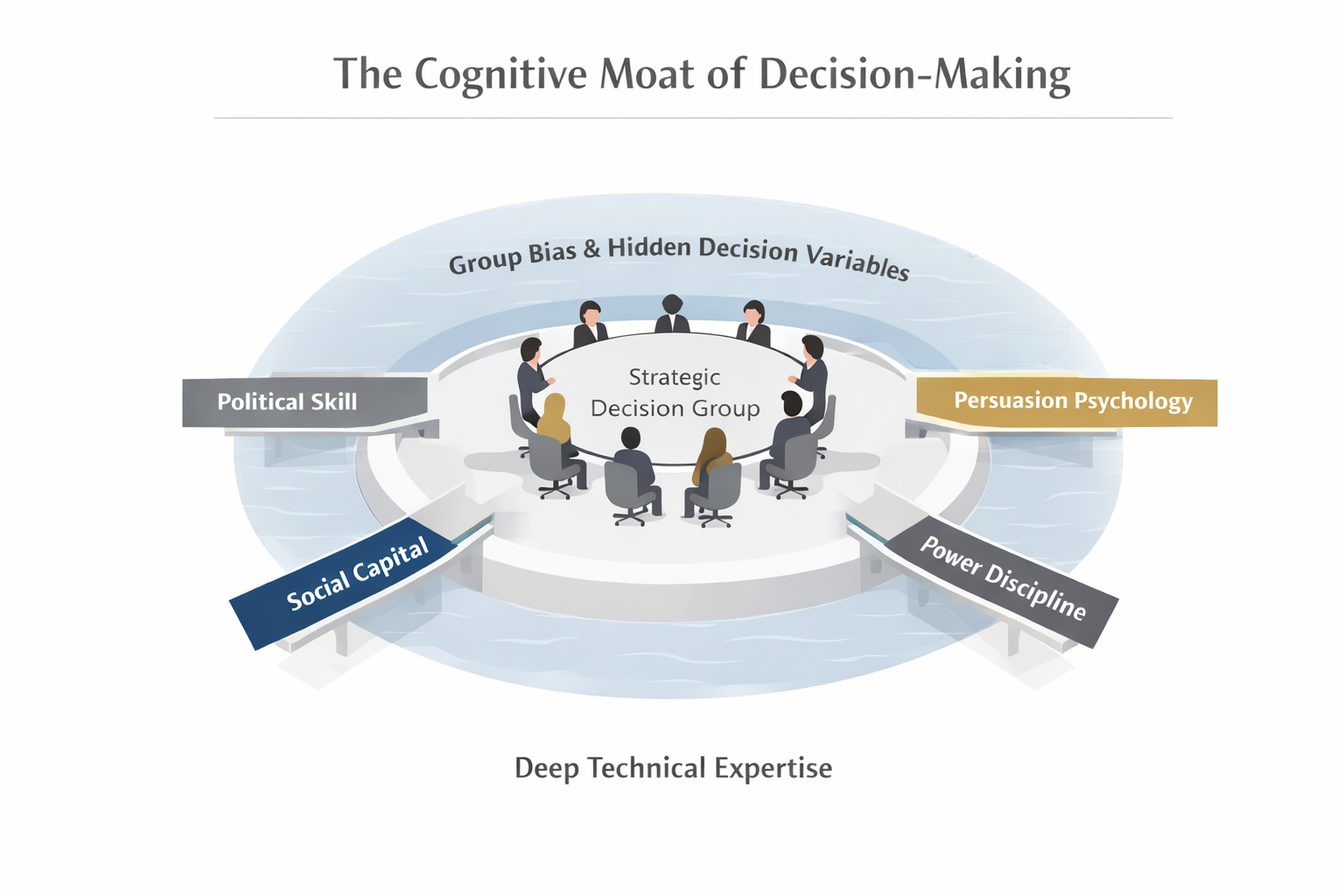
As a highly trained, experienced subject matter expert, you may sometimes experience a quiet but persistent frustration.
You have depth.
You have evidence.
You have spent years refining judgment that others rely on.
Yet when strategic decisions are made, you feel your voice carries less weight than less-informed voices. This is rarely because your analysis is wrong. It is more often because expertise and organisational influence operate on different logics.
Technical excellence is necessary. It is rarely sufficient.
In organisations, or in any group, decisions are not made by pure evidence alone. They are shaped by competing variables like corporate objectives, risk tolerances, political dynamics, group biases, culture, and individual concerns. Experts are trained to optimise for correctness, but “correctness” is relative depending on how the current context is impacted by these variables.
If this perception gap about “correctness” is not understood, your expertise is at risk of becoming marginalised for reasons that have nothing to do with your knowledge and analysis. If it is understood and practiced deliberately, your expertise can drive decisions.
The Reality of Strategic Decision-Making
Classic strategy research once assumed that organisations made decisions through largely rational, analytic processes. Contemporary theory presents a more complicated picture. Strategic decision-making is now understood as a social learning process involving multilevel discourse across executives, middle managers, and boards. Decisions emerge through interaction, not an algorithm alone.
As described in the Oxford Research Encyclopedia of Business and Management, strategic choice unfolds in “unstructured” and “messy” ways rather than through purely a purely mathematical calculations. Evidence may inform decisions, but it does not determine them in isolation.
This explains a tension many experts experience:
You deliver a technically rigorous analysis.
The decision does not align perfectly with that analysis.
The process feels political rather than rational.
The conclusion many experts draw is that playing the political game is necessary, which is affront to their values and beliefs. The more accurate conclusion is that the organisation is operating within a broader decision calculus that is sometimes unclear or unspoken.
For the expert, presenting correct data is not enough. You must demonstrate how your data alters the weighting of the criteria that executives care about, but may not discuss openly.
Some questions to consider:
1. When a decision goes against my recommendation, do I assume it doesn’t make sense, or do I try to understand what other factors might be influencing it?
2. Do I make an effort to understand all the different factors that are being considered in an important decision?
3. Do I mainly focus on showing that my analysis is right?
4. Do I try to uncover the factors leaders might not talk about openly, like career risk, office politics, or reputation?
Bias and Its Impact on Deep Insight
Even when hard data and evidence is available, group dynamics and cognitive bias often distort how that data is processed, interpreted, and acted upon. There are over 180 different cognitive biases that most people have to varying degrees. Some of these biases worth considering here are groupthink, social influence effects, hidden profile bias, and group polarisation.
The hidden profile effect is particularly relevant to deep specialists. It occurs when critical information is distributed unevenly across group members, yet discussion centres on shared information rather than unique expert insight. Groups prefer what everyone already knows. Specialised knowledge can be overlooked precisely because it is, well, specialised.
These biases create what might be called a cognitive moat around the executive table, or any group needing to make a decision. The deeper your expertise is in relation to the group you are trying to influence, the more effort is required to influence that group’s collective reasoning. Hence, if you put all your eggs in one basket via a single PowerPoint presentation to another team, you are unlikely to be successful.
History provides significant examples. Diane Vaughan’s analysis of the Challenger disaster described a process of “normalisation of deviance,” in which repeated small technical anomalies gradually became acceptable within organisational culture. The Boeing 737 MAX crisis revealed similar patterns of cultural pressure, silence, and risk normalisation.
In both cases, expertise was present, but it was not sufficiently integrated into closed leadership cohorts. For experts who care about the integrity of their field, expanding your influence is not vanity. It is a critical responsibility that you owe to yourself, your organisation, and community.
Some questions to consider:
1. Do I depend on one formal presentation to persuade a group, or do I build understanding with people before the decision meeting?
2. Have I made an effort to share my expert knowledge so others understand it and feel it belongs to them too?
3. Do I understand the personal and group biases that might affect how people hear and judge my message?
Political Skill as a Responsibility
In my experience, there is one thing that frustrates my expert clients more than anything else – “playing politics”. It is often an affront to their values and they believe it takes away the purity of making the right decision. They sometimes describe it as theatre, manipulation, backstabbing, or self-promotion.
The research does not define it that way. A lifetime ago, my own Master’s thesis about the use of political skills in organisations reinforced this view. Politics is nothing more than human nature. It is what inevitably happens when people come together in a group with different individual goals, fears, personalities, and histories.
Ferris and colleagues describe political skill as the ability to understand others at work and use that understanding to influence action in ways that advance organisational objectives. It comprises four dimensions:
Social astuteness – accurately reading interpersonal dynamics.
Interpersonal influence – adapting behaviour to different audiences.
Networking ability – building diverse and useful connections.
Apparent sincerity – being perceived as authentic and trustworthy.
Political skill correlates with career effectiveness across industries. It does require an ethical compromise. Political skills are the application of emotional intelligence in groups. Importantly, like emotional intelligence, political skill can be learned. It can be practiced and strengthened.
For the expert, this reframes politics from a personality trait to a professional discipline to improve influence and impact.
Some questions to consider:
1. Do I refuse to engage in office politics on principle?
2. Can I clearly see and understand the power dynamics, relationships, and unspoken tensions in my organisation?
3. Do I adjust how I communicate based on who I’m speaking to?
4. Am I building a wide range of important relationships before I actually need them?
The Psychology of Persuasion
The field of social psychology adds another layer. Robert Cialdini’s research on influence demonstrates that people rely on mental shortcuts when processing complex information under time pressure or in groups. These include principles such as reciprocation, commitment and consistency, social proof, authority, and liking.
For the technical professional, these principles have precise applications that can be implemented:
Build social capital by contributing value to people before you need to influence them.
Secure small, early alignment on premises before advancing your major recommendations.
Demonstrate cross-functional support for technical positions.
Establish credibility before critical meetings.
Frame yourself as a partner in shared objectives rather than a critic of strategy.
None of that can be achieved by waiting for a single presentation to another team, including the leadership team. It is built up over time and does not require acting in a way that is not authentic. It does, however, require an acceptance and awareness of reality that we are all irrational, tribal beings.
Evidence must be delivered into a receptive environment. You need to build that environment first.
The Myth That Performance Is Enough
A persistent belief among experts is that a well-thought-out, evidence-backed proposal should win the day, but research and experience contradict this assumption. For example, Jeffrey Pfeffer’s work on power argues that influence is a neutral organisational tool – meaning that it is not inherently good or bad. Those who acquire it shape outcomes and do so sustainably. Those who avoid it relinquish impact.
Power in this context is not about dominance or hierarchy. It is about the capacity to ensure your voice is heard, understood, and acted upon. There are five forms of power in organisations, one of which is expert power, a concept I will explore deeply in a future series of articles.
Pfeffer identifies behavioural disciplines that contribute to power acquisition: visible confidence, strategic networking, deliberate reputation management, and willingness to claim earned authority. These behaviours often feel uncomfortable to experts who feel their work should “speak for itself.” In my experience, that can work, but it's like tying your hopes on the role of the dice. There are too many factors at work.
The ethical question is not whether you will engage with power dynamics. It is whether you will engage with them responsibly.
Some questions to consider:
1. Do I get small agreements and support from different teams before putting forward a big recommendation?
2. Do I build trust and alignment before I need people’s support, or do I rely on one big, high-pressure presentation?
3. Do I pay attention to how others see me through my words and actions, or do I assume my work will speak for itself?
Many experts resist developing influence because they fear becoming inauthentic. Authentic leadership research suggests the opposite: influence is most durable when grounded in self-awareness, balanced processing of information, an internalised moral perspective, and relational transparency.
Developing greater influence does not require adopting corporate theatre. It requires disciplined communication of what you genuinely believe, expressed in language others can absorb. Small, consistent adjustments in how you present, connect, build relationships, and frame your work are more powerful and lead to better outcomes than trying to become someone that you are not.
Reclaiming the Expert’s Seat at the Table
The tension between expertise and influence is not a personal failing. It is a structural feature that is inherent in complex systems like typical organisations. However, ignoring that structure carries consequences.
When expertise is sidelined, be it through a conscious decision or some unspoken rule of the culture, organisations will drift toward speed over accuracy, the sales pitch over analysis, and short-term comfort over long-term resilience.
For the expert, the path forward is not easy but clear:
Strengthen political skills as a professional capability.
Practice knowledge brokering across organisational boundaries.
Apply evidence-based influence skills ethically.
Proactively build relationships before you actually need to.
Engage with your expert power without abandoning integrity.
Maintain your authenticity while adapting communication for your audience
This is not self-promotion. It is stewardship. At a global level, it is a social responsibility.
Because complex problems require your intelligence and expertise is heard and acted on.
I am developing an Expert Influence Self-Audit that will include the four dimensions of political skills and authentic expert power. If you would like to be informed when the first draft of this audit is available, please click here to let me know.