The Architecture of Expert Influence
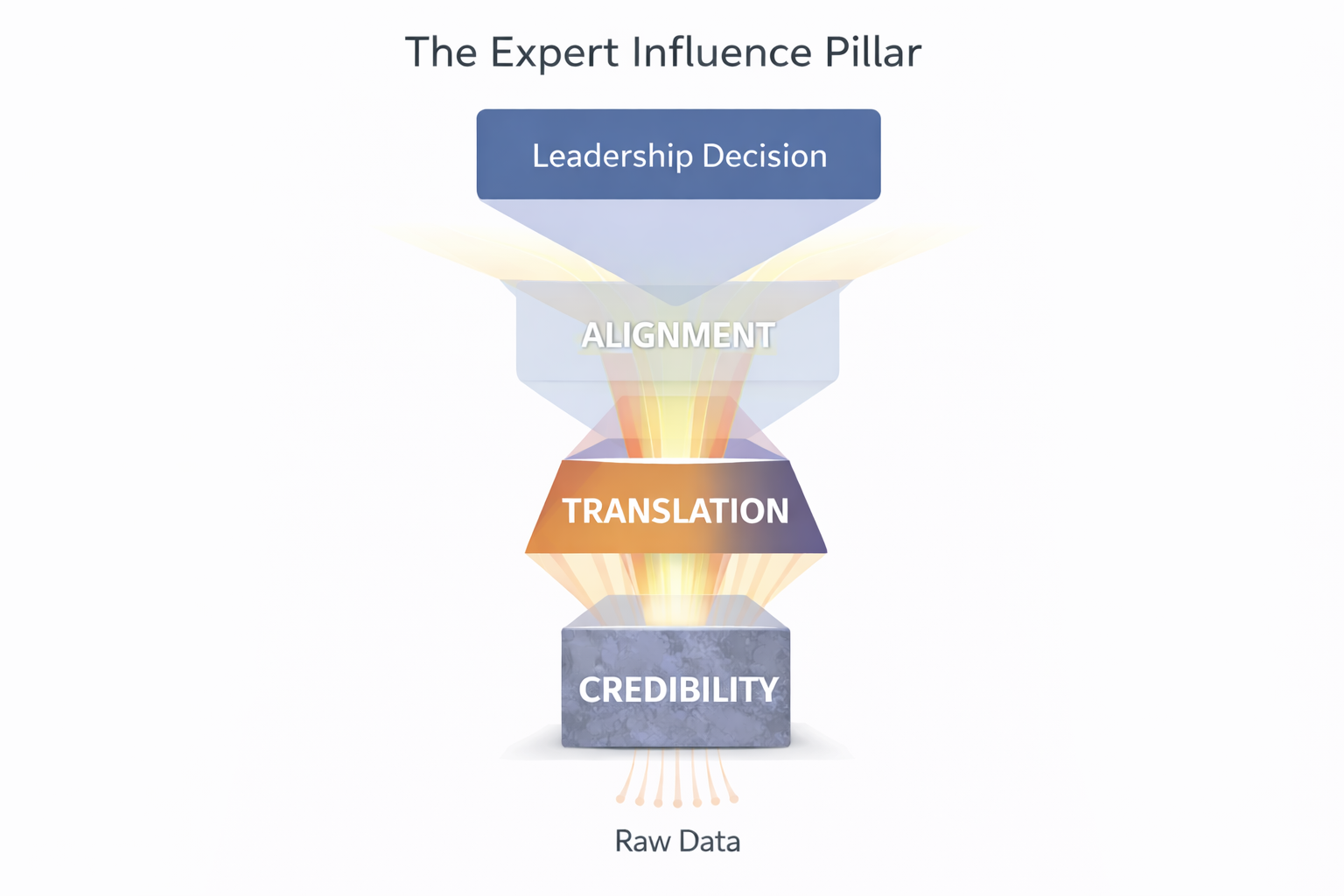
Influence in complex organisations does not flow automatically from competence. It is mediated through many factors such as human systems, decision architectures, and incentive structures. When experts assume that sound reasoning and data analysis alone will persuade others, they often collide face-first with the irrational reality of human-based systems.
To understand this collision, we need to examine what influence actually requires. The factors influencing influence are complex and numerous. This article will explore three interdependent layers:
Credibility
Translation
Alignment
Most experts invest heavily in the first. Few are taught to practice the second and third with equal discipline.
The Competence Trap
The first obstacle is not a lack of ability but an over-reliance on an expert’s ability by their organisation, and by the expert themselves.
First coined in 1988 in the Annual Review of Sociology, the “competence trap” was a reference to individuals who are exceptionally capable in a specific domain who become indispensable in that domain. As a result, experts become the reliable fixers.
At first, this reinforces professional identity and positive reputation, but over time, their identity narrows. They become “the fixer”. The organisation becomes dependent on their brilliant execution and fire-fighting, which can lead to the expert being structurally locked into operational contribution rather than strategic influence. This, but not this factor alone, can lead to functional fixedness, where deep mastery in one domain can narrow the lens through which new problems are viewed. Professional identity becomes intertwined with specific methods and tools.
Furthermore, as expertise deepens, it becomes intuitive. What has become muscle memory for the expert appears like voodoo and magic to their stakeholders. This can lead to the Dunning–Kruger effect -high performers frequently underestimate how specialised their knowledge truly is. What feels obvious to them is not obvious to others, who tend to overestimate their own knowledge. When experts assume their conclusions are self-evident, translation (the second layer) becomes more difficult, which has a negative effect on credibility (the first layer).
Shifting beyond that identity can trigger learning anxiety, a concept explored in organisational learning theory by Edgar Schein, or experienced by anyone who has required to learn a completely new skill on the job. The discomfort of being visibly incompetent while acquiring new capabilities pushes many people, not just experts, back toward the safety of technical mastery. However, as experts may feel their identity and influence are based primarily on their competence, learning anxiety has a greater detrimental effect on them.
For the organisation, if too many of their experts get caught in the Competency Trap, it can lower innovation, engagement, and performance. Sometimes, it leads to increased turnover of internal expertise. It can also increase silos and reduce the ability of the organisation to adapt.
Layer One: Credibility as Foundation
Credibility is rarely about credentials and competence alone. For credibility to be positively experienced by others, it needs to be an integrated combination of competence, character, and care.
· Competence provides the technical justification for one’s perspective.
· Character builds trust that judgment will be exercised ethically.
· Care demonstrates investment in others’ development, psychological safety, and success.
These three components of credibility have been continually reinforced in leadership research over decades and reflect lived organisational experience. People, including senior leaders, do not follow those who are merely correct. They are influenced by experts whose judgement is dependable and aligned to their values, goals, and incentives.
Some questions to consider:
1. Do the people who make decisions actually know the evidence behind your work, or is it only other experts who understand it?
2. Does the way you act and communicate match the organisation’s values day to day?
3. Are you helping others grow so they might support and speak up for your ideas in the future?
4. Are you regularly sharing your specific expertise in a clear way, or just assuming people already know what you’re good at?
For experts seeking influence without formal authority, credibility must be overtly visible beyond their competence. Their credibility is the foundation layer, but relying only on this layer may lead to frustration.
Layer Two: Translation as Strategic Practice
Research on knowledge translation and brokering, particularly in healthcare and public policy, describes the role of “linkage agents” who create a bridge between research and decision makers. Such agents understand that knowledge does not transfer linearly in organisations. It is exchanged in full or in part, interpreted, codified by individuals, and contextualised within priorities and constraints.
Experts may communicate at the altitude at which they think. Decision-makers operate at a different altitude, so knowledge translation requires some flexibility:
Adjusting the depth and breadth of the message according to the audience.
Framing implications and recommendations, not just presenting data and facts.
Connecting technical details to strategic priorities and avoiding domain-specific terminology.
Connecting technical findings to concerns and objectives of senior decision makers as a team and as individuals. These objectives could include risks, regulatory posture, financial, brand impact, operational continuity, or resource constraints. They will likely also include career concerns, maintaining face, or interpersonal conflict within the team.
This is sensemaking. Technical accuracy without translation erodes credibility and trust.
In organisations, particularly with the rise of advanced analytics and AI, the volume of information, disinformation, and AI-slop can overwhelm decision capacity. Out of necessity, the expert’s role is shifting from providing answers to clarifying which signals matter and why.
Some questions to consider:
1. Do I speak at the level leaders think about, or am I in the technical detail I’m comfortable with?
2. Do I just give more information, or am I pointing out what actually matters to my audience and why?
3. Do I clearly link my technical findings to what leaders care about, such as risk, reputation, or limited resources?
4. Am I so focused on being technically correct that I make it difficult for others to understand and trust what I’m saying?
Layer Three: Alignment within Human Systems
Even well-translated insights can fail if they are misaligned with the “decision architecture” of an organisation and individuals making those decisions. Organisations rarely decide based purely on rational methods, although they sometimes believe they do. Decisions are filtered through incentives, power structures, political realities, and timing.
Most organisations will typically operate with layered decision processes:
Technical verification;
Evaluative assessment; then
Strategic weighting.
By the final phase, resource constraints, reputational considerations, stakeholder expectations, and competing priorities will dominate any debate. Individual biases, motives, relationships, incentives, and history will also colour a rational process. Experts who ignore this structure often experience frustration. Their analysis may score highly on methodological rigour yet lose to initiatives that better align with current executive rational and non-rational priorities.
Alignment then requires:
Understanding strategic priorities.
Recognising informal influence networks.
Mapping stakeholder incentives and fears.
Synchronising proposals with budget cycles, reporting windows, and governance rhythms.
Timing really matters. In my own experience, I have seen many brilliant ideas never see the light of day for no other reason than bad timing. Every organisation has its own cadence: quarterly reporting, annual strategy reviews, product cycles, and regulatory submissions. And those are just the documented processes. The larger the organisation, the more likely there are unspoken, covert decision-making processes. Presenting a technically correct proposal outside these windows significantly reduces the probability of adoption.
Alignment is not manipulation. It respects that institutions are human systems, not purely rational machines.
Some questions to consider:
1. Do I time my recommendations to fit with the organisation’s decision schedule so they don’t get rejected simply because the timing is wrong?
2. Do I honestly understand what influences decisions behind the scenes and shape my message around what people care about, fear, or stand to gain, instead of assuming the best idea will automatically win?
3. Do I know where my input sits in the decision process right now and adjust how I present it to match what matters right now?
4. Am I acting as if the organisation makes decisions purely on logic, or am I paying attention to the human side — power dynamics, competing priorities, personal biases?
The Identity Shift: From Specialist to Strategic Partner
Having broader influence requires moving away from an exclusive personal identification with mastery in a field of expertise. Technical leadership and influence is not just a larger version of technical work. It is qualitatively different.
Organisational researchers from Peter Drucker onward has emphasised that high-performing knowledge workers require decentralised authority and emotional intelligence, including empathy, conflict navigation, and perspective taking.
Influence is not self-promotion. It is responsible stewardship of hard-won knowledge and expertise. Organisational research, cognitive psychology, management theory, and lived experience reinforce that technical excellence alone rarely determines impact. Our flawed, non-rational, biased human systems have an overweighted impact.
If experts concentrate solely on their credibility, assuming their work will speak for itself, they leave the translation and alignment layers unaddressed; they will reduce their influence and impact.
Strengthening influence requires disciplined and deliberate practice:
Practising translation without reducing rigour.
Practising alignment without compromising integrity.
Moving through learning anxiety rather than retreating into familiarity.
The stakes are beyond individual careers. Complex global challenges, whether technological, regulatory, environmental, or societal, require informed judgment. If experts do not shape these decisions, the less informed will. The architecture of expert influence is therefore not optional. It is a social responsibility.
I am developing an Expert Influence Self-Audit that will include the four dimensions of political skills and authentic expert power. If you would like to be informed when the first draft of this audit is available, please click here to let me know.