Why Your Evidence Isn’t Enough

A dashboard on a computer screen highlighting various metrics
If you are a subject matter expert, you were likely trained, coached, or mentored in environments that reward precision, deep analytical thinking, and evidence-based reasoning. It is what helps you excel at being an expert in your field. Your credibility, at least to some extent, has been built on your ability to analyse complex information, test assumptions, and produce conclusions grounded in verifiable data.
Because of this, it is natural to assume that strong evidence should be persuasive on its own, and within most technical professions, that assumption is correct. Scientific and analytical fields operate on the expectation that the strongest argument is the one supported by the strongest evidence. Unfortunately, organisational decision-making rarely occurs under purely scientific conditions. Rational decision-making is anything but rational.
As a result, you may occasionally experience a frustrating situation:
You present sound analysis and well-supported recommendations, yet your insights fail to gain the traction they deserve.
This experience is extremely common among experts across fields such as engineering, healthcare, analytics, finance, technology, and research. It is not a reflection of the depth of your expertise. More often, it reflects a difference between how expertise is communicated and how organisational decisions are actually made.
Understanding these differences can significantly increase the impact of your work.
Why You May Naturally Rely on Facts and Evidence
Your professional technical development has likely been heavily influenced by the scientific method and positivism, which holds that valid knowledge comes from measurable, objective evidence. From this perspective, claims and solutions are justified through data, experimentation, and logical reasoning.
As a result, you may operate with a mental model that assumes:
If the evidence is clear, the conclusion should be obvious.
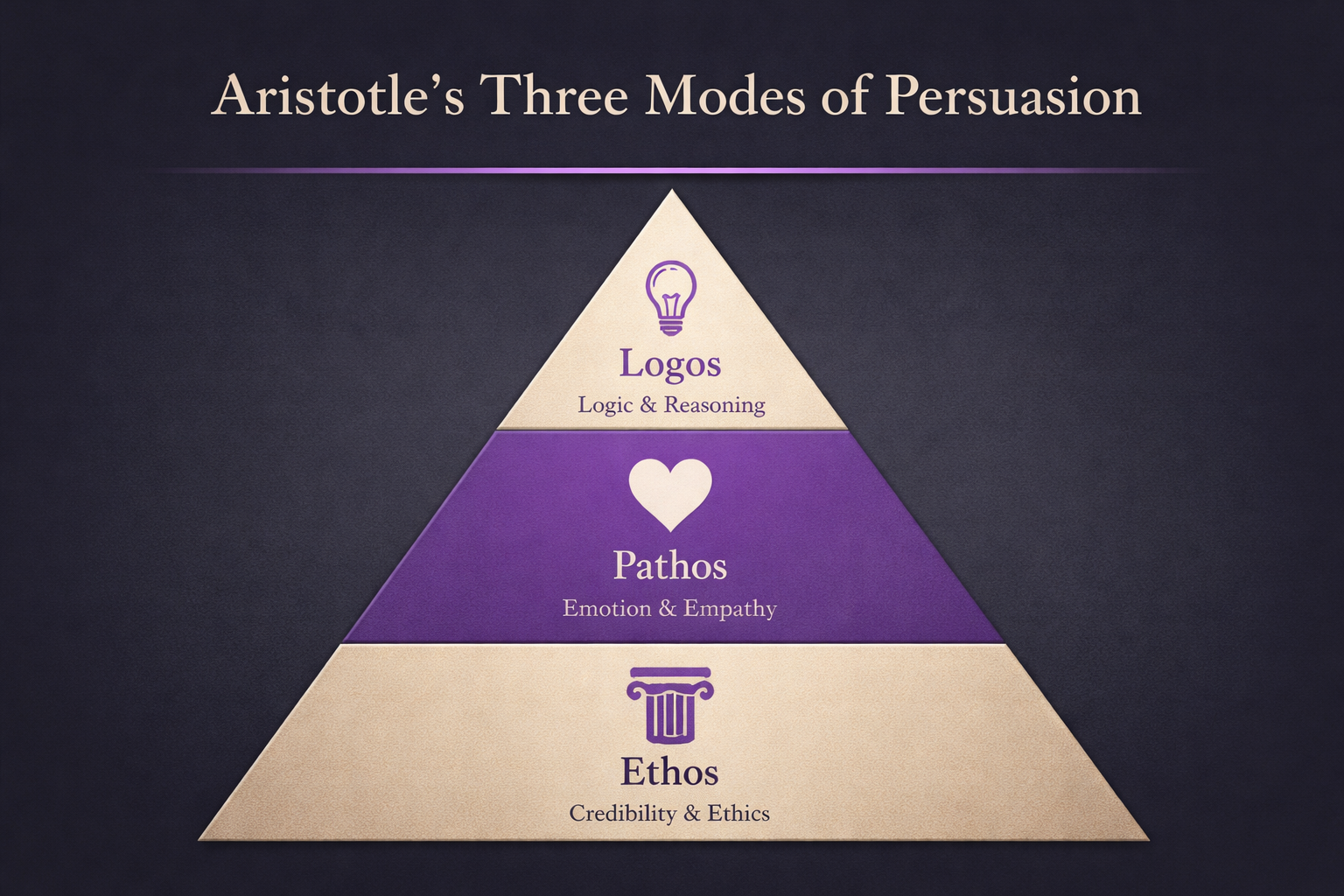
The Greek philosopher Aristotle wrote about ethos, pathos, and logos in his writing in Rhetoric. In his "artistic proofs," Aristotle introduced these three modes of persuasion to analyze how a speaker can convince an audience through credibility (ethos), emotion (pathos), and logic (logos). Yes, this model is 1700 years old, but lived experience and research between now and then prove the model has stood the test of time – logos can be persuasive, but if there is a likelihood of an emotional response to your logos, it is likely to be insufficient on its own.
As an expert, you probably operate very strongly in Logos and Ethos. Your credibility (ethos), in part, comes from your knowledge and your proven ability to support your claims with evidence. You may also deliberately avoid Pathos because emotional appeals can feel inconsistent with the objectivity expected in your technical work.
However, human decision-making, particularly in groups, rarely relies on logic alone. Decisions are influenced by conflicting priorities, incentives, relationships, competing agendas, group dynamics, and cognitive biases. When your evidence slams into that environment, it will compete with those other factors, and more.
Why Persuasion May Feel Uncomfortable for You
When I encourage experts to incorporate storytelling or persuasion techniques, many feel uneasy or suspicious at first. If you have experienced this reaction, you are far from alone. Several factors contribute to this discomfort.
1. Concern About Manipulation
You may worry that persuasion and storytelling rely on emotional influence rather than pure rational reasoning. Because your professional identity is likely built on a foundation of intellectual integrity and rigour, the idea of shaping a narrative might feel uncomfortably close to manipulation.
In reality, storytelling does not have to replace data and evidence. When incorporated into your communications, conversations and presentations, it simply helps your audience understand why the evidence matters and engage with your data. There is significant research showing that our brains are hard-wired to engage with and be influenced by stories more than by data alone.
2. Tension With Professional Identity
Technical professions often emphasise scepticism toward anecdotal reasoning - information or data that is based on personal experiences or observations. As a result, being asked to use stories or examples can feel as though you are abandoning analytical rigour. In practice, however, narrative techniques are not meant to replace data. Instead, they are meant to help people relate to its implications in a human context.
3. The Vulnerability Challenge
Effective storytelling sometimes involves sharing experiences, setbacks, or lessons learned, which may feel risky. Revealing uncertainty or mistakes can appear inconsistent with the false expectation that experts should demonstrate mastery in their field. In fact, research on leadership communication suggests that when handled transparently by those with established credibility, vulnerability can humanise and strengthen professional standing.
4. Cognitive Switching Costs
Your daily work may involve structured, rule-based thinking, analysing systems, modelling outcomes, or solving complex problems. Storytelling and persuasion, by contrast, require a different mental mode. It involves interpretation, empathy, reading the room, and framing data in context. Shifting between these modes can be cognitively demanding, which is why many experts find it mentally tiring. Fortunately, like any other professional skill, storytelling and influence improve with practice and can become second nature. With deliberate practice, it will take less time than it took to develop your expertise.
Benefits of Narrative Communication
Improved memory and recall
Information you embed in stories is remembered significantly better than information presented as lists of statistics or technical explanations.
Greater engagement
Your stories provide context and meaning, helping your audiences understand why a piece of information matters.
Reduced resistance to new ideas
When people become immersed in a narrative, they are less likely to immediately counter-argue. This phenomenon, known as narrative transportation, can help audiences be more receptive to new perspectives and ideas.
Potential Risks
At the same time, narrative communication must be used carefully by those whose credibility is based on their expertise.
Narratives can distract from evidence
If your story becomes too compelling, your audience may focus on the narrative rather than the data supporting it.
Complex ideas can become oversimplified
Important nuances may be lost when translating technical insights into simplified stories.
Narratives can be misused
There have been well-documented cases where persuasive storytelling was used to mask weak evidence or fraudulent claims. You and your audience will likely have had their own such experiences in the past.
For these reasons, your goal should not be to replace your analytical rigor with narrative techniques. Instead, the aim is to combine your rigorous evidence with communication that helps others understand its implications in a way that is relatable to them.
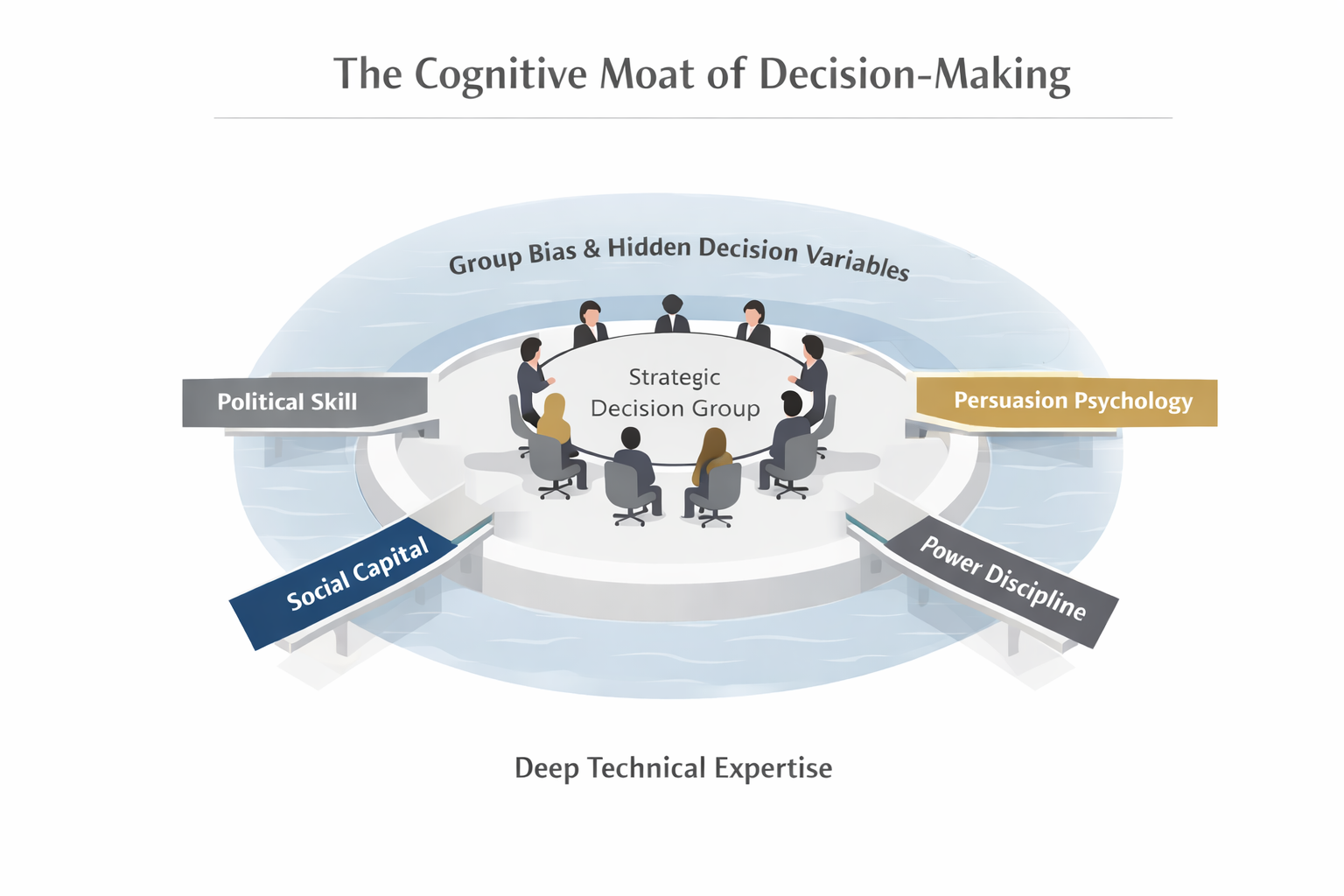
The Obstacles You May Face
Even if you decide to strengthen your storytelling skills, there are often organisational and cognitive barriers that limit the influence of expertise. I have written about these obstacles in previous articles, such as “The Cognitive Moat of Decision Making”.
Practical Ways You Can Increase Your Influence Through Storytelling
There are specific and pragmatic storytelling techniques that can help you strengthen the impact of your expertise.
Use a “Before–After–Bridge” Narrative
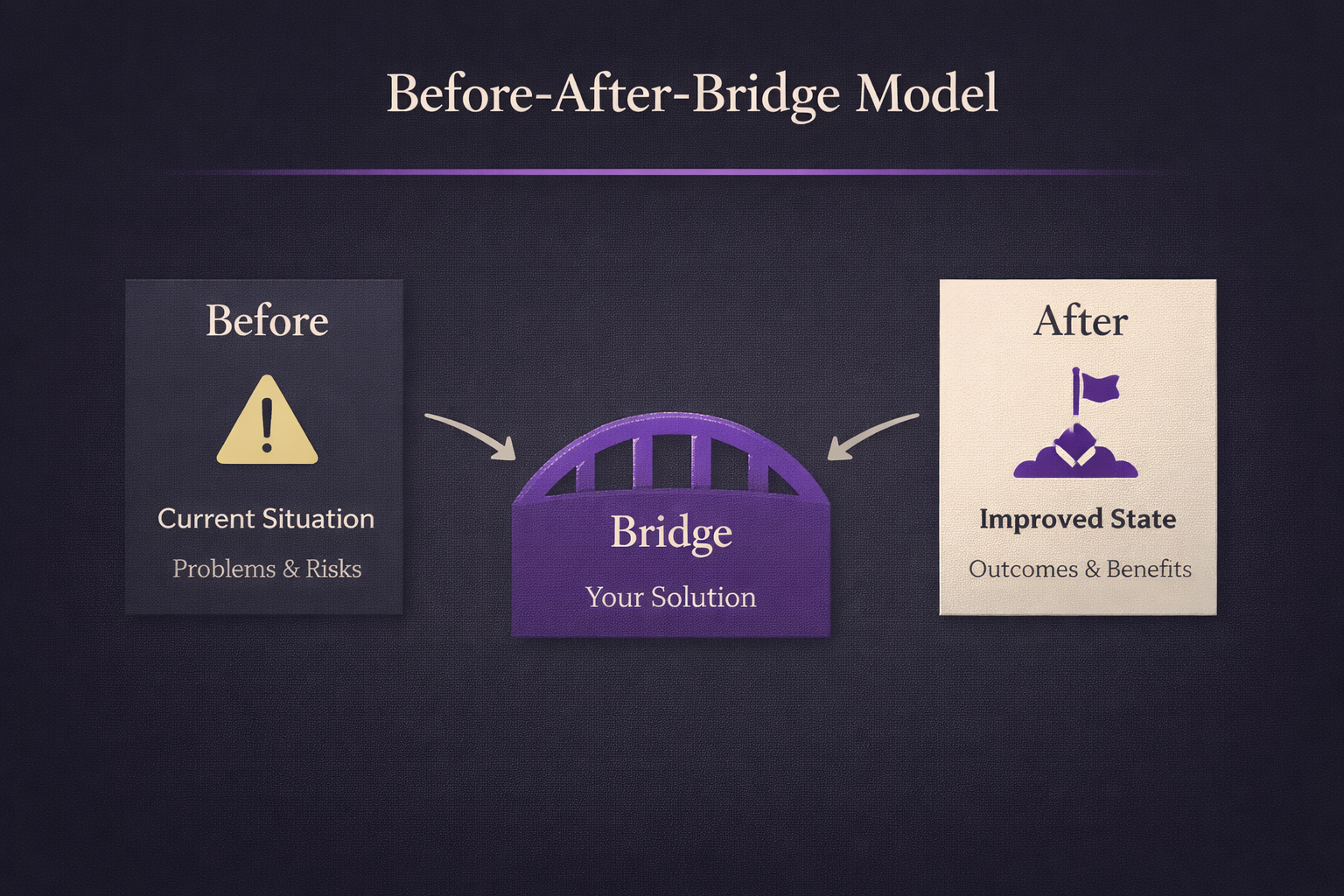
A basic approach to storytelling you can apply to a technical explanation is the Before–After–Bridge model. This approach helps your audience quickly understand the relevance of your expertise and solution without requiring them to process all the technical details immediately.
Start by describing the “Before” state in terms they will feel are important: the current situation, including the risk, inefficiency, threat, or constraint that the organisation is facing. Provide actual examples that your audience would have likely experienced themselves. This establishes group understanding and demonstrates that you understand the business problem, not just the technical system.
Next, you describe the “After” state: what the group could experience if the issue is solved. This might include improved performance, reduced risk, increased capability, or new business opportunities. Importantly, this step allows leaders to visualise the outcome before you introduce your beautiful technical solution.
Finally, you present the “Bridge”, which is your technical recommendation. At this stage, the audience already understands the problem and the desired future state, which makes the technical explanation far easier to absorb. The solution is no longer perceived as a complex technical proposal; it becomes the pathway that connects the present situation to the desired outcome.
This technique works particularly well when explaining complex engineering, data, or technology solutions because it frames the technical work within a clear organisational narrative that your audience is more likely to relate to.
Walk the Audience Through Your “Journey of the Problem”
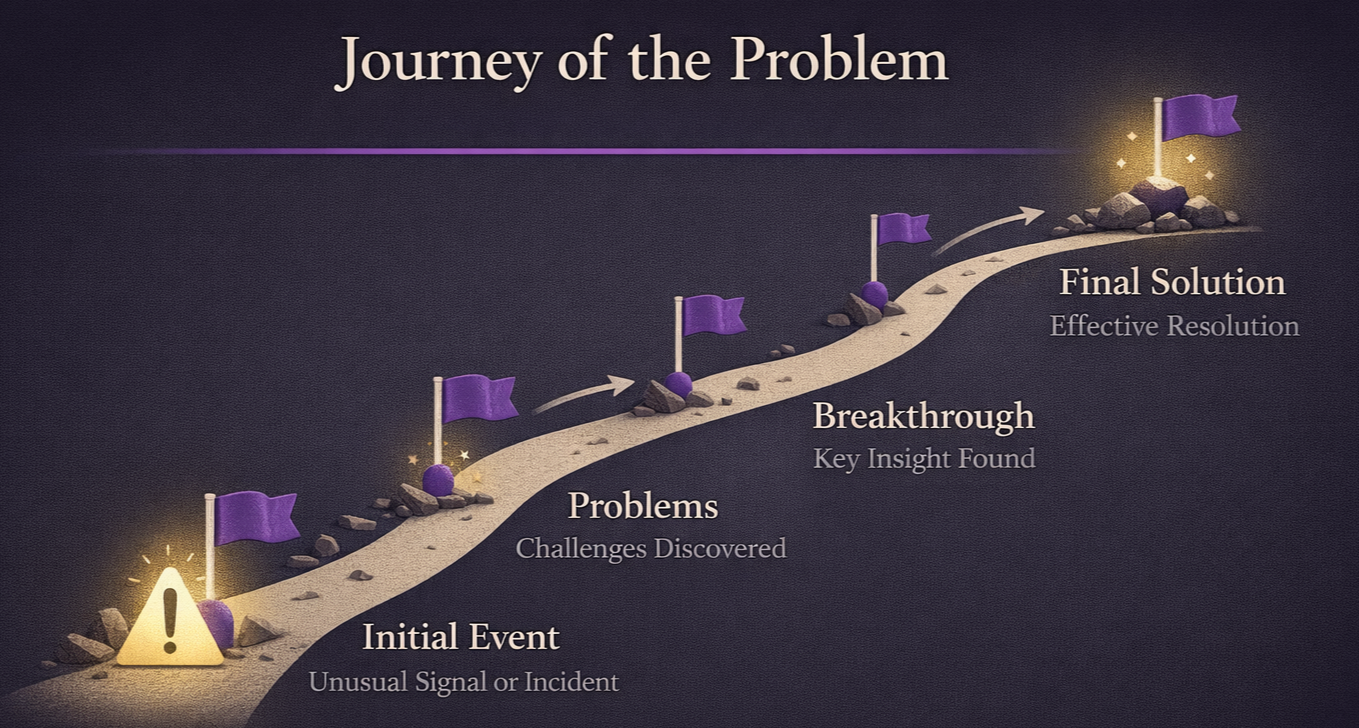
Another effective storytelling technique is to structure your explanation around the journey of the problem rather than the architecture of the solution.
Experts often instinctively start by describing the solution itself: its components, design logic, or analytical methodology. While this approach is logical from a technical perspective, it can be difficult for non-specialists to follow and does not create an emotional connection with the solution.
Instead, you can guide the audience through the sequence of events that led to your discovery of the issue.
For example, you might begin by describing the initial signal that something was wrong. Perhaps a performance anomaly, an unusual pattern in the data, or an unexpected meeting with a frustrated customer. You then share the series of events that revealed deeper causes, showing the reasoning you followed as you analysed the problem.
As the story unfolds, ensure your audience sees how each piece of evidence led logically to the next insight. Also, share the emotional highs and lows you and others may have experienced on this journey. By the time you introduce the final solution, the audience has already travelled through the investigative process with you.
This approach accomplishes two things simultaneously. First, it helps the audience understand the complexity of the problem without overwhelming them with technical detail. Second, it creates a story that your audience will likely relate to. Third, it reinforces your credibility as an expert by revealing the disciplined reasoning that produced the solution.
Adjust Your Altitude
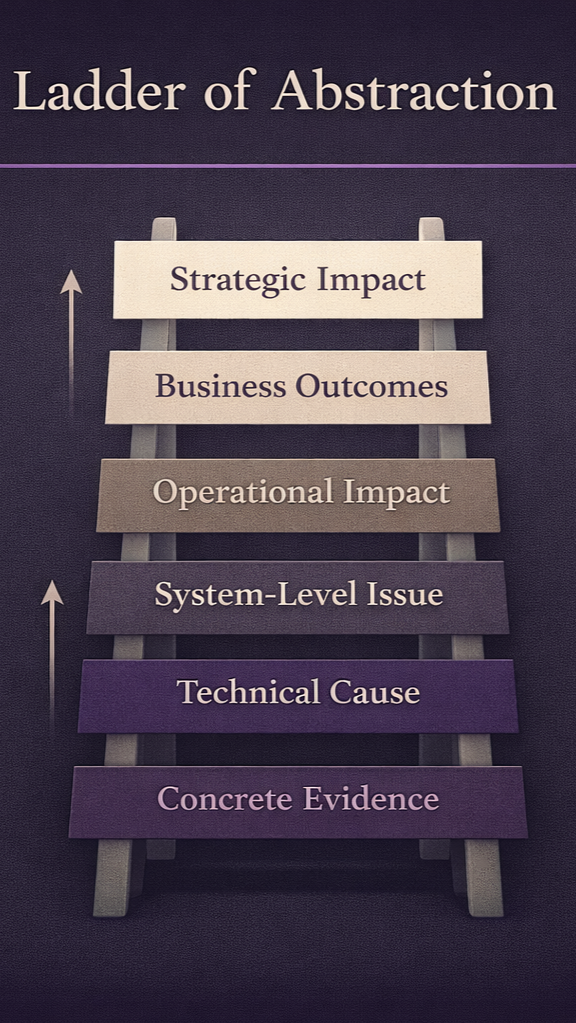
One useful mental model is the Ladder of Abstraction.
At the bottom of the ladder are detailed technical findings. At the top are strategic implications and organisational outcomes.
When communicating with leaders, it often helps to deliberately move between these levels:
Move upward to explain why your solution matters for strategy
Move downward to provide specific evidence or examples
This approach helps decision makers connect your analysis with their priorities.
Build Alignment Before Formal Presentations
Influence rarely happens in a single meeting. One of the most common pieces of advice I give my expert clients is “don’t put all your eggs in a single basket [i.e., into a single presentation to the executive]”. In my experience, it has been proven repeatedly that the most successful experts spend time socialising and lobbying ideas informally before formal decision points.
This may involve:
discussing early insights with stakeholders
testing assumptions
building shared understanding across teams
proactively building relationships before you need anything from each other.
By the time a formal recommendation is presented, key stakeholders are already familiar with the core ideas, and you will have likely identified any potential resistance and support.
Your Challenges Are Normal
If you have ever felt frustrated that strong evidence did not automatically persuade others, you are not alone. It is one of the most common frustrations shared by my coaching clients.
Experts are trained to pursue truth through careful analysis of the data and evidence. Organisations, however, operate within complex social systems where decisions are shaped by psychology, relationships, incentives, and competing priorities.
The most influential experts are rarely those who abandon analytical rigor. Instead, they are those who retain their commitment to evidence while developing the ability to translate their insights into language that others can understand and act upon. They understand that decision-making is often more of an emotional process than a rational one.
When you combine technical depth with clear communication and compelling storytelling, your expertise will not only be accurate but impactful.
Expert Practice works closely with organisations and experts to increase the influence and impact of expertise. If you want to know more about how, we can arrange a no-commitment meeting to explore options for you as an expert or for your organisation. Click Here to arrange a meeting.